
|
 |
 |
 |
 |
 |
 |
 |
 |
 |
 |
 |
 |
 |
 |
 |
 |
Protection of Human Rights in Emerging DemocraciesThere is a correlation between respect for human rights and the development of democracy in democratically emerging countries, and even in countries with long-established democracies. The existence of respected human rights is inconceivable under authoritarian regimes. Dictatorships do not constitute natural environments for the protection of human rights. Similarly, no true or evolving democracy can possibly exist if its growth is not associated with a parallel development in human rights protection. Thus, democracy and human rights protection are two interrelated themes. This correlation is clearly found in Article 21 of the Universal Declaration of Human Rights. more  Religious Freedoms
|
|
|
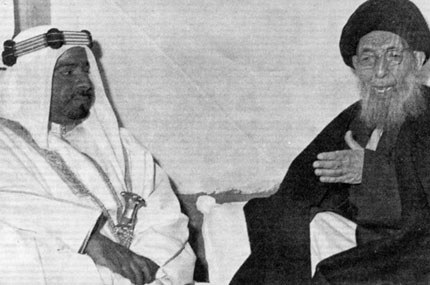
| Prior to Bahrain’s independence: The late Sheikh Isa, the Emir of Bahrain, in a meeting with the late Sayyed Muhsin Al-Hakim, the Shiite Marja’ (religious authority), in Najaf |
To differ with and criticize government policies and positions is also legitimate.
Confrontation and clashing mostly occur upon transgression of what is commonly known as the political ‘constants’.
This refers to the agreed upon constants: maintaining the system of government; preservation of national unity; protection of religious and denominational diversity; rejection of violence as a methodology for change and political action.
Although the overwhelming popular majority in Bahrain believes in these national constants, some political factions - not the grass roots - have caused a high level of political, social and security instability and confusion due to their contravention of these constants, whether it was consciously planned or otherwise due to being carried away in the heat of political conflict. more
Bahrain’s Civil Society:
A Second Take-off
Bahrain’s Civil Society: A second Take-off
In recent years, and for various reasons, the civil society in Bahrain underwent a state of recession amounting to a stalemate. This state of affairs is in total contrast to the situation of the Bahraini civil society as it took off following the Royal reforms of 2001, which led to the establishment of hundreds of societies that coloured Bahrain with a rainbow of cultural, social, legal and other activities.
As the strong presence of the civil society in any country is an indicator of the vitality of the people and the advancement of the state’s legislation; and since the activities of the civil society are of utmost necessity to both the state and the community, we need to plan for a second take-off of this civil society to enhance its effectiveness, productivity and impact. more
Civil Society Experience in Bahrain
Hasan Moosa Shafaei
A strong civil society, in any country, serves not only as a useful tool for creating positive change, but more importantly, as a force to achieve two vital targets:
 |
|
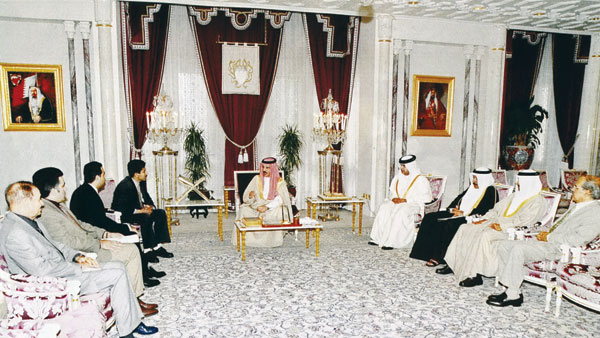
| Founders of Bahrain Center for Human Rights in a meeting with the King |
1/ Protection of the democratic change, whether comprehensive or gradual, against the elements of extremism and terrorism; safeguarding the nascent state and preserving democratic values;
2/ Abortion and besiege of any extremist alternative that may arise.
At least this is the lesson learned, for instance, from the experience of the strong and mature civil society in Tunisia in the face of the fundamentalist stream which later grew into an extension of Al-Qaeda and ISIS by feeding on errors, partial administrative failure, as well as political and security vacuum. more
Bahrain Deserves a Chance to Prove Itself on Human Rights
Pauline McCabe*
 |
|
| Professor
Pauline McCabe, Criminal Justice expert |
Bahrain’s record on human rights has been repeatedly criticised following the treatment of protesters in the wake of the “Arab Spring” of 2011. Most recently, the human rights organisation Reprieve published a report last month calling on Northern Ireland to stop training security forces and ministry of the interior staff in Bahrain because of the countries “dire” human rights record.
While I respect the important work of Reprieve, I want to explain why, in this instance, I think that the organisation is wrong. more
Positive Engagement is
Bahrain’s Way Forward
In an article entitled ‘Bahrain deserves a chance to prove itself on Human Rights’, published in The Irish Times, on October 17th, 2016, Professor Pauline McCabe, offered an objective assessment of the efforts and progress made by the Ministry of interior’s Ombudsman in Bahrain, despite being a relatively new institution, established in compliance with the BICI recommendations.
Professor McCabe emphasized the importance of the policy of practical engagement in helping countries like Bahrain overcome their shortcomings as far as Human Rights are concerned; such as illustrated by the UK-funded work undertaken by Northern Ireland Cooperation Overseas (NI-CO) in the fields of training and capacity building for Bahrain’s security forces and Ministry of Interior’s staff. more
Areas of UK-Bahrain Cooperation
in the Human Rights Dossier
The historical relationship between Bahrain and the United Kingdom is not the only reason why the government of Bahrain sought technical support from its historical ally, in modernizing its human rights institutions and related aspects.
Undoubtedly, the historical relationship does play a role in promoting trust.
But the historical relationship has also resulted in a better British understanding of the reality of the Gulf region and its people, culture and how to conduct reforms in that region.
These days, Gulf nations view the United States as a reckless friend who has no grasp of history or culture, but rather seeks to impose its views in a manner that leads to chaos rather than reform and modernization. more
UK Foreign Office:
Our Goal is Justice & Building Effective Human Rights Institutions
The Government of Bahrain has gone to great lengths to create several institutions pertaining to the justice system and human rights. Foremost among these institutions are the bodies concerned with monitoring, investigation and grievances, which include: The Office of the Ombudsman, the National Institution for Human Rights (NIHR), Special Investigations Unit (SIU) and the Prisoners’ and Detainees’ Rights Commission (PDRC).
Like any fledgling institution, these bodies need time to establish themselves and gain the necessary experience to perform their roles and achieve their objectives. more
How to Respond to
International Questions & Criticism
Criticism is still being levelled against Bahrain by international human rights bodies and by some states at the Human Rights Council (UNHRC).
Several queries are directed to the Government about specific human rights issues. Thus, many problems arise in this regard:
First: Organizations complain about the lack or tardiness of responses.
Second: Responses may be insufficient and do not properly or completely answer the specific questions asked. more
Freedom of Worship & Combating Religious Motivated Violence
Political violence in the name of religion has become widespread in the Arab world which witnesses a proliferation of organizations that use religion to justify violence in the beginning, only to turn it into a political investment in the end.
This issue is not purely cultural; nor is it just a historical legacy brought about by warring sectarian and denominational communities. Religious violence is also, first and foremost, a phenomenon which has current roots, and its players do not belong to the distant past, but are actually living among us. more
The High Coordinating Committee
for Human Rights in Bahrain (HCC)
With the continuing ascendancy of the Human rights and its widespread impact on the international relations arena, it has become necessary for states to exert greater efforts to improve their human rights affairs, in accordance with the principles and criteria agreed upon by the international community, and later included in agreements, treaties and protocols that are binding to all parties signatories to them.
By virtue of their memberships in international conventions, treaties and protocols, states automatically become subject to the international mechanisms designed to ensure their fulfilment of their obligations. more
Bahrain:
|
